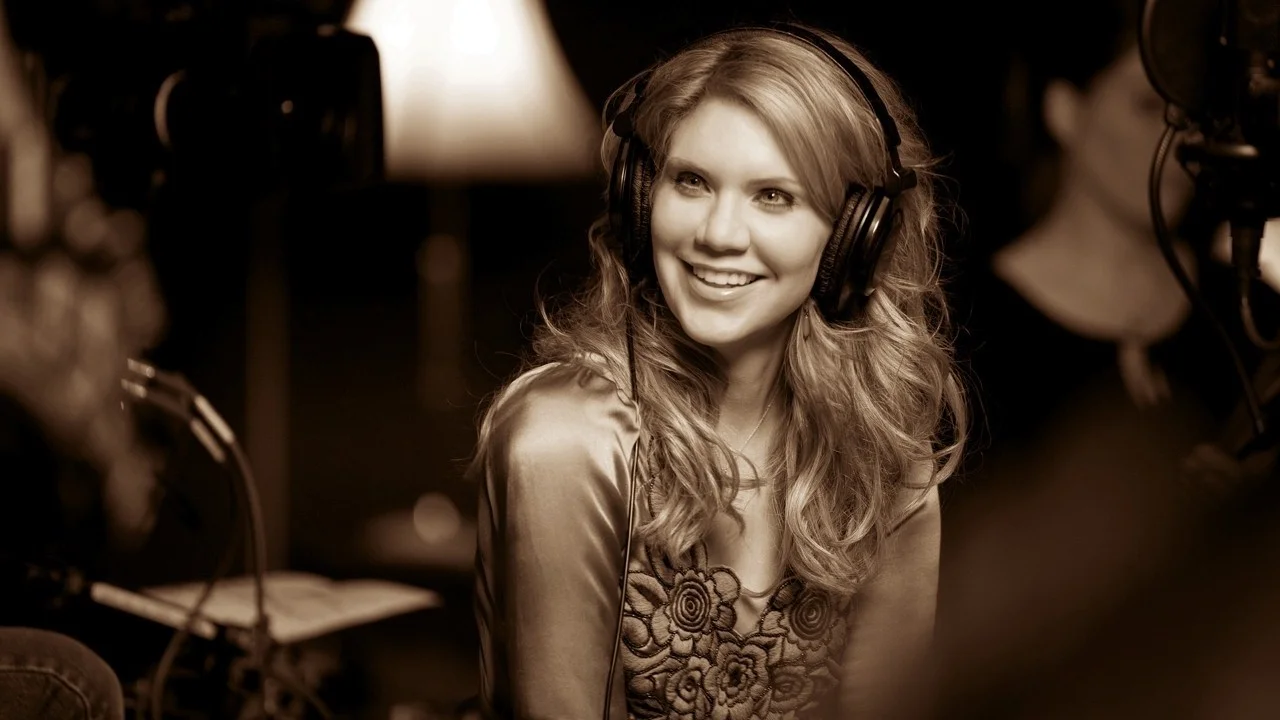
Start by separating lead and harmony
The lead usually carries the recognizable melody or central narrative. Harmony parts add other pitches around it, while unison singing places voices on the same line. A doubled lead in a studio recording can create thickness without becoming a separately moving harmony. Listen to the relationship between voices rather than counting how many people appear in the video.
In a band with several singers, the lead can move from one member to another. A low harmony can be just as structurally important as a high one. Try following the lowest audible voice through a chorus, then the highest, and finally the melody again. The chord may become clearer once you stop hearing the singers as one undifferentiated block.
A documented acoustic ensemble
Alison Krauss & Union Station’s official Live release identifies Dan Tyminsky’s baritone vocals and Ron Block’s tenor vocals alongside their instrumental roles, with Barry Bales on bass and Jerry Douglas on Dobro. It also documents the Louisville Palace recording across two evenings in 2002, with one separately recorded track. These credits give listeners a grounded way into the ensemble.
Use the release to hear how a singer can move between playing and vocal support. Do not assume every named musician sings on every track. Follow an individual selection and consult its available performance footage when identifying a visible part. The combination of release notes and a specific performance is stronger evidence than assigning roles from a general band biography.
Why the same blend can feel different live
A live mix includes a room and a performance moment, while a studio master may present voices with a different degree of separation. Microphone position, arrangement and the surrounding instruments all influence what you perceive. A voice that seems less prominent may be singing a quieter part, sitting differently in the mix or simply competing with another sound.
Watching can change your hearing. Once you see a singer enter, a previously hidden line may become easy to follow. That is useful, but repeat the passage with your eyes closed. The second pass helps distinguish an audible part from an expectation created by the picture. An edited concert film also chooses what to show, so a camera cut is not proof of a musical entrance.
Build a harmony-role card
Choose one studio recording and one official live performance of the same song. Write the source, the phrase being compared and the apparent roles. Use tentative language when the mix makes an attribution uncertain. You can still describe how the blend changes without claiming to isolate each singer in the master.
| Role | Observation prompt | Useful comparison |
|---|---|---|
| Lead | Where does the main melody sit? | Prominent or woven into the blend |
| Upper harmony | When does it join or leave? | Whole phrase or selected words |
| Lower harmony | Does it anchor the chord? | Sustained or independently moving |
| Ensemble | Do consonants and endings align? | Together or deliberately staggered |
Listen for restraint as well as size
The most revealing moment may be the one where a harmony does not enter. If a verse leaves the singer alone and a later phrase introduces other voices, the arrangement has changed the social scale of the story. That is a listening interpretation, not a claim that you know the singers’ private intention. Point to the entrance that supports your response.
For a contrasting contemporary catalogue, Little Big Town’s Pain Killer offers a band identified with four-part harmony, while Midland’s artist account emphasizes its own thick vocal blend. Use those as new listening paths rather than interchangeable examples. Ask which singer carries the story, where the ensemble becomes audible as a group and how the instrumental arrangement makes room for it.
Harmony listening also rewards a quiet first pass. If you continually raise the volume to find a part, the exercise becomes fatiguing. Choose a clearer passage or another documented performance instead. A mix that does not expose every singer separately can still present a carefully balanced ensemble sound.
Follow the sources
Explore the original records, archive material and published accounts behind this article. Each source describes a particular release, performance, collection or event; keep that context when comparing examples.
Related artist guides
 Little Big TownArtist, recordings & live dates ↗
 The CastellowsArtist, recordings & live dates ↗
 Alison KraussArtist, recordings & live dates ↗